
|

What is the Second Circle?
|
Time and again our eyes were brought together
by the book we read; our faces flushed and paled
Dante, Inferno
|
|
The Second Circle
Review
THE LAND OF GREEN PLUMS
by Herta Muller
reviewed by C.J. McCarthy
HERTA MULLER was born in 1953 in the Banat region of Romania, home to a German-speaking minority incorporated into Romania in 1918 from the Austro-Hungarian Empire. That minority were embraced by Hitler as part of the greater Germany, and many served in the German army in WWII. Muller's own father served in the SS, and remained unrepentant to his death. At university, Muller became involved in a group of German-speaking students who formed Aktionsgruppe Banat. They soon came under the scrutiny of the Romanian Secret Services, leading to expulsion from university, harassment and interrogation. This process and the resultant mental deteriorations, betrayals and suicides is the subject of Muller's third novel, the prize-winning The Land Of Green Plums (1993; translated by the poet Michael Hoffman).
|
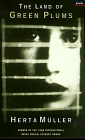
THE LAND OF GREEN PLUMS
by
Herta Muller
You may order this title by clicking on the link corresponding to your delivery region below: orders are fulfilled by our partners at Amazon.
AMERICAS, AFRICA,
AUSTRALASIA & ASIA
EUROPE
|
The novel begins in the dormitory of a girl's university, focusing initially on Lola, a country girl, who embarks on a series of sexual liaisons with strangers and eventually becomes involved with a Party official. When the affair becomes a burden to him, she is found hanged in the dormitory. At this point, the narrator has not yet distinguished herself:
Someone asked, Where are you going? ... Maybe, in those first three years in the little room, I was that someone. Because, except for Lola, anyone could have been that someone. And someone in the bright cube did not like Lola. That meant everyone.
By the end of the novel, she will openly express emotion and opposition to the regime that has killed several more of her friends:
I wished that [my interrogator] would carry a sack with all his dead. I wished his hacked-off hair would smell like a newly-mown graveyard whenever he sat at the barber's. I wished his crimes would reek when he sat down at the table with his grandson after work. That the boy would be disgusted by the fingers that were feeding him cake.
Initially, her resistance takes the form of a growing perception of the perverseness of Romanian society, her descriptions of which strive to reflect the surreal logic of the regime: so exceptional are they that high-heeled shoes walk about with a life of their own, the wearer unseen; men hunger after Lola like starved dogs, farmers come to the city to work in factories to build tin sheep and wooden watermelons. These form part of a set of images which are constantly returned to in the novel. Unripe fruit (the green plums of the title) is consumed greedily, hungry slaughterhouse workers steal fresh offal and drink the animals' warm blood... all conveying a sense of that the general populace are steadily teaching themselves to consume the poisonous realities of the world in which they live. These images achieve even greater resonance after we are told that the leukaemia-ridden dictator habitually has blood drawn, vampire-like, from the heads of new-born babies, to provide himself with red blood cells.
The narrator makes friends with a group who refuse to accept that Lola's death was suicide. They gain the attention of the secret police for such 'subversive' activities as singing folk-songs and reading German literature. (That the novel was written in German is itself significant, representative of an assertion of difference which was persecuted under Ceausescu, trying to gather Romanian nationalistic sentiment around himself in opposition to the German-speaking minority--a significance inevitably lost in translation.) The novel catalogues the emotional, moral and mental deterioration of the various members of the group under the inevitable interrogation, surveillance and harassment which follows. A folk-song the narrator has been singing is rewritten by her interrogator as a threat to her and her friends, which she is then forced to sing:
I sang without hearing my voice. I fell from a fear full of doubt into a fear full of absolute certainty. I could sing the way water sings. Maybe the tune came from my singing grandmother's dementia. Perhaps I knew tunes she had lost with her reason. Perhaps things that lay fallow in her brain had to pass my lips.
The narrative does not organise itself according to any strict chronology, but rather by a sequence of association, including the narrator's memories of her home life. These fragments are presented in a broken grammar and deadpan voice which is resolutely understated, on the surface conveying little emotional involvement on the narrator's part. The driving narrative, of course, is the development of the narrator's psychological state, inferred from the associations she makes between one phenomenon and another, and from the terms in which she perceives the world. The repeated use of a store of key images creates a claustrophobic, inescapable reality which the narrator carries around within herself, even after she has escaped to Germany.
Similarly, unable to see the world in any terms but those he's learned under Ceausescu, one of the group commits suicide even after managing to leave Romania. Talking of the friend upon whom this character was based, Muller has said in interview: '...he may have done it himself. But his nerves were in such a state, they had tormented him so much and he had left too late.' That reality follows also the narrator literally: despite having fled to Berlin, she is somehow visited by the woman who had been her closest friend and confidant in Romania—now an informer for the secret police, it emerges. Of all that has happened, it is this which affects the narrator most, seeing how the personal has been subordinated to political purposes.
Indeed, the novel acutely portrays the way in which the worst instincts—fear and greed especially—are manipulated by the state to gain the complicity of the general populace. Leaving the university, she strips her bed:
When I picked up the blanket to pull off the cover, I found a pig's ear in the middle of the sheet. That was the girls' way of saying farewell. I shook the sheet but the ear didn't move, it was sewn on in the middle like a button.
By the end of the novel, it is obvious that those who have suffered under this regime can no more shake off the sense of suspicion with which they continue to regard everyone and everything about themselves than they can the memory of such images as these. By the end of the novel, even those who have survived the regime are unable to shake off the sense of suspicion with which they have learned to regard everyone and everything about them. Just as the reader is unable to forget the images by which the regime is represented. 
C.J. McCarthy
Reviews by C.J. McCarthy at The Second Circle:
Break it Down by Lydia Davis
Land of Green Plums by Herta Muller
The Age of Wire and String by Ben Marcus
Brief Reviews including Arnon Grunberg and Harry Mulisch
|
|
|
| |
|


