The Sword Cabinet
by
Robert Edric
All Territories
|
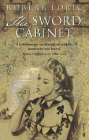
The Kite family, onetime mythical daredevils and high artists of the trapeze, have fallen to earth in post-War England, and their collective memory has devolved upon a hustler and exhausted illusionist named Mitchell. He is on a search to recover his mother's life and to escape the shambles he's made of a seaside club fallen so low that the only crowd it can muster for a beauty pageant is the crowd of those seeking his blood. Moving across multiple timelines, Robert Edric traces the history of the Kite family and of a murder investigation spiralling around Morgan, the last of the great escapalogists who dooms himself in his wildest feat, one too dangerous even for Houdini: freezing himself alive. Whatever threadbare gains Mitchell makes from his questioning, he at least gathers the strength for his own final performance. Unfortunately, his story pales so against that of the larger characters, that by the end the reader may not much care about his fate. Paul McRandle 
|
|
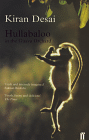
It's almost too easy to claim that Kiran Desai's debut novel, Hullabaloo in the Guava Orchard, is the embodiment of Italo Calvino's values of lightness, quickness, exactitude, visibility, and multiplicity. But it needs to be said, for this is no earnest first novel, no disguised memoir: her social satire is brief, delightful in its humor, precise in its caricatures, and generously encompasses an entire Indian village--including the wildlife. The book concerns the story of young Sampath Chawla, a layabout who, in proper heroic form, garners fame by rising above society, in this case by climbing into a tree. From there Sampath becomes a focus for villagers willing to believe he holds spiritual insight into their lives when in fact he simply draws on time spent as a postman reading their mail. Soon enough the whole world comes spinning in around this timid boy who wishes for nothing more than escape. Speaking of Calvino's literary values, there is perhaps also a slight tipping of the hat to his Baron in the Trees; in any case, I am sure he would have well enjoyed Ms. Desai's crafty, sensuous novel. Paul McRandle
|
Hullabaloo
in the
Guava Orchard
by
Kiran Desai
Americas,
Africa
& Asia
Europe
|
|

Memories of
My Father
Watching TV
by
Curtis White
Americas,
Africa
& Asia
Europe
|
With such a domestic title reeking of the rec room, it's easy to see how one father/reviewer at Amazon felt himself duped by Curtis White's recent fevered novel. Yet how appropriate that this book about killing fathers should be given unknowingly by a daughter to her dear dad. For what sounds like a gentle and nostalgic baby-boomer memoir reveals itself to be a nasty and funny or funny and nasty mix of TV room battles, rotoscope frenzies, and myth. The novel arrives as a series of incarnations: Highway Patrol, Sea Hunt, Combat, Have Gun Will Travel, TV shows so little worth repeating that by their absence they've become something potent in White's memory. Most of these episodes take place somewhere between the living room, the stage set, and the fictional locale, the father less their star than their scapegoat. His humiliations are endless--from confessing on a quiz show that he's best described as a turd in a hat to playing a German bridge used by Nazis and blown sky-high by his son. Most other times he lies comatose on the couch, only rousing himself if his children dare to interrupt his show. But as Dad sinks in his stupor, kids screw on the sofa, Maverick is born as a foetus in a boot, and a huge, singing worm is squeezed from Ben Cartwright's head. It's obvious that White's models include Kafka and Barthelme, but he avoids sounding merely derivative. While he can be sneeringly arch, through much of Memories White homesteads television's imaginative landscape with all the zeal of a man opening up a new frontier. In the process, he makes other writers on the subject sound like mere armchair travellers. Paul McRandle |
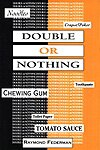
| Pulling out the seventies' titles of Raymond Federman is almost like reviewing old Beefheart albums--it's not as if they haven't been in print over the years, but they haven't been given credit for the amazing (and funny) things they are. Federman is a French-born writer of Jewish descent who's mother and father hid him in a closet when the Nazis came to take them and his two sisters away. Not a lot there to build a comic career. He left France after the war, moved to the U.S. and dragged himself through a series of cities and mishaps that have, after being thoroughly remixed, distorted, retold, contradicted, and denied, become a good part of these novels. Double or Nothing, the earlier of the two, contains the triply-nested narratives of an almost non-existent "stubborn and determined middle aged man" telling the story of a paranoid author who plans to lock himself in a room for a year with only noodles to live on so he can write the story of a shy, young frenchman just arrived in New York after the war. The book looks harder to read than it is--lines of text run backwards and forwards, build up in pyramids and cut with jagged sawteeth. Almost every page is built according to a different design, but despite the dadaist randomness, if you read along word by word any difficulties are overcome by the energy of his prose. After all, what you're reading are endless (but somehow funny, over and over) lists and worryings of what the paranoid writer can afford for his year locked away: precisely how many boxes of noodles, whether tomato sauce once a week for flavour might bust the bank, how he's going to store his 104 rolls of t.p. so he can count the horses on his wallpaper, and always interrupting these pointless turns of frenetic ordering with the hapless encounters of the young French guy fixated by the crotch of a woman on the subway, screwing his friend's mother, and trying not to sound pathetic about his awful past. What’s not to like? Paul McRandle |
Double
or
Nothing
by
Raymond
Federman
Americas,
Africa
& Asia
Europe
|
Take It or Leave It
by
Raymond
Federman
Americas, Africa
& Asia
Europe
|
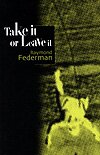
Take It or Leave It eases the typographical turmoil of Double or Nothing, but torments his narrators--this time an anonymous someone is standing in front of an unruly audience telling the story told to him by a young French guy ("Frenchy"), now somewhat older, making his way out of his military barracks in North Carolina to his planned great American adventure. He wants to hitch across the country to meet up with a ship in San Francisco that'll take him off to the Korean War, but first he's got to get his check from Vermont. Like Double or Nothing, the stories here fall back on themselves to be reworked and criticized by the crowd. A pious voice asks why Frenchy didn't feel exploited as a foreigner by the "structures of Capitalism":
"Do I understand correctly? UNBELIEVABLE! You guys are really a bunch of perverts! The stuff you can come up with! And now I'm asked if I understand THE QUESTION? ... Yes his story you find it amusing. You think that perhaps it is tellable recitable since you stand there listening to it with gaping mouths. And why not? Interesting even (even a bit obscene). Don't you think so? Nonetheless you guys would have liked to have had his experiences his adventures and his avatars. His bitchy existence! N'est-ce pas? ... But for you guys there is always a solution as it was once suggested: You simply contrive a little kingdom in the midst of the universal muck and then shit on it."
Sending up Kerouac and drawing on his love of Beckett, Federman can't help but get caught up in his machinations, cancelling his story as he goes. He knows full well that "in fact, however, there can always be more words." Paul McRandle
|
| It's as if all the pleasures that should have saturated the FC2 Reader were drained off by its co-editor Ronald Sukenick into his, to use a silly word, delightful new novel, Mosaic Man. From the title on, Sukenick's punning feverishly upon the bible, (his chapters: Genes, Ex/ode, Umbilicus, Numbers, Autonomy, Profits), to devise his own "wholly book." The story, such as it is, concentrates around Ron the author and various anagrammatic spin-off identities: Ronda, Rona, ROM, RAM, Aron, covering in a variety of modes from dream narrative to autobiographical confession his/their search for the Golden Calf. It begins with a comic overture shimmering with the novel's themes: Genetics and the Word, Jewishness and anti-Semitism. He plays with an old tape recording of his family, transcribing it complete with blank space for dropouts, then moves into feverish childhood vision as Ronnie and Captain Midnight escape New York in a flying wing to bomb Nazis. He returns to earth as a callow young man making a go at bohemian Paris in the fifties, confessing more than we likely want to hear about his mistreatment of women. He's a pig, but a sorely self-aware pig. As if in penance (though many years later), Ron travels to Jerusalem only to find himself caught up in more sinister conspiracies. A Texan millennialist hopes to blow up the Dome of the Rock and rebuild the Third Temple, mysterious others seek the Golden Calf, and the Golem lurks in the shadows. But Sukenick is too crafty to trap himself in either thriller pulp or the literature of consolation. What he does come up with as a credo, is more of a critique, "You thought it was a religion? What makes you think it's a religion? Being Jewish is an art . . . You got to have talent." I can't speak for being Jewish, but talent? Sukenick's blessed. Paul McRandle. |
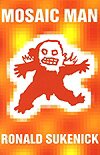
Mosaic Man
by
Ronald Sukenick
Americas, Africa
& Asia
Europe
|
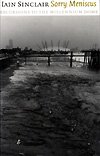
Sorry Meniscus
by
Iain Sinclair
|
To Americans, London's Millennium Dome is more likely to recall Logan's Run or a football stadium than St. Paul's Cathedral. It's equally unlikely that many outside of Britain will take much interest in a critique of it. Iain Sinclair's little tract will only earn their attention when it comes closest to a rant, satisfying ill-spirited if universal urges to see great plans collapse and rich men shown for fools. In this Sinclair doesn't spare himself; his attacks on "the Teflon Hedgehog" are unremitting. There's no pretence of fair-mindedness here, and the photographs of this "poached egg sunset," "this skin with no pudding," give little reason for one. Engulfing 200 million pounds of lottery money and fouling traffic, the dome in return provides "all the excitement of a slightly dirty circus tent." Does it matter that others will enjoy the tent once filled? Not to Sinclair, yet he never attacks the potential audience for bad taste. In fact, he has the polling to show that most of Britain sees it for the waste it is. He attacks those who profit from it by abusing the public's good will. A slight book, Sinclair nonetheless shows how much local history and pragmatic utility the powerful are happy to sacrifice in the name of entertainment. As he puts it, "Give us the bread and we'll give you the circuses." Paul McRandle
All Territories
|
|


